More candidates won't fix bad screening
Sourcing is upstream pipeline work: job postings, talent outreach, employer branding. It gets candidates to the door.
Most TA teams spend the majority of their time and budget here. That makes sense when your pipeline is genuinely too small. But for many organisations, the pipeline is large enough. The problem isn't too few candidates. It's too little confidence in evaluating them.
Screening is where predictive validity lives
Screening is downstream evaluation against defined criteria.
Research shows it's the strongest lever for improving outcomes. The difference between structured and unstructured screening: roughly 60 vs 31 high performers per 100 hires.
It's also where bias creeps in fastest. Without predefined criteria and scoring models, every evaluator applies their own mental model.
“A pipeline of 200 poorly screened candidates doesn't produce better hires than 50 well-screened ones.”
Why most teams over-invest in sourcing
Pipeline metrics are visible and easy to track. Application volume, channel conversion rates. These show up in dashboards.
Screening quality is harder to measure. How do you quantify interview accuracy? That requires outcome data most organisations don't collect.
So teams invest heavily in the top of the funnel (progress is measurable) while the evaluation step that determines quality stays unstructured.

4 shifts that move budget from volume to accuracy
Define before you source: Set evaluation criteria before sourcing begins.
Assess early: Psychometric assessments in under 30 minutes give you structured data before the first interview.
Make screening consistent: Structured interviews with predefined questions and scoring anchors.
Close the loop: Track which scores predicted performance and which channels produce your best hires.
How Alva connects sourcing to decisions
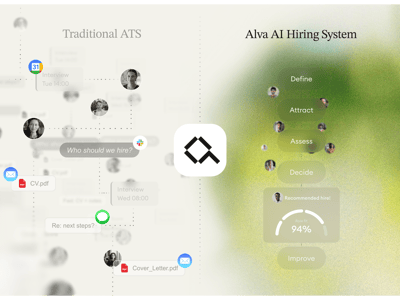
Role-specific success profiles define what to look for. Adaptive assessments screen early. Role Fit scoring ranks mechanically. Analytics track which channels produce the highest-quality hires.
The two sides reinforce each other. Better criteria sharpen sourcing. Better screening reveals which channels are worth the investment.