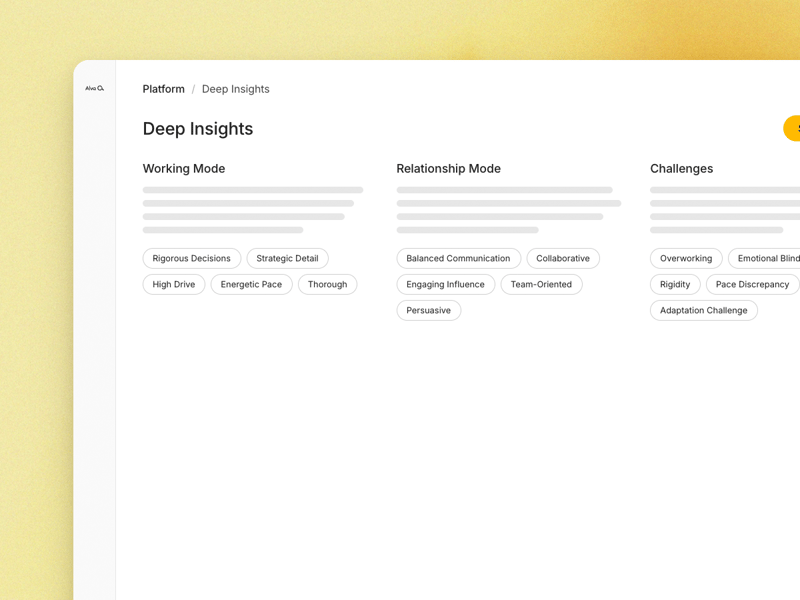
Going deeper than a Role Fit score
For early-stage screening, a Role Fit score and a personality profile do most of the work. You're filtering for basic relevance. You don't need a 40-page narrative.
For late-stage selection, senior hires, and leadership development, the question changes. It's no longer "is this person broadly relevant?" It's "what kind of great are we getting, and where will they need support?"
That's the gap Deep Insights closes.
The depth used to live in 40-page reports
Before Deep Insights, the only way to get this read on a candidate was a long-form report from a trained psychologist. Useful, but expensive, slow, and built for a different era of hiring.
The shift: the same depth, generated automatically from the same Five-Factor data Alva already collects, written in the report voice your hiring team already trusts.
"What kind of great are we getting?"
Three layers, built around what stands out
Deep Insights organises the candidate's personality data into three layers. Each maps to how people actually operate at work, and each is grounded in specific facets from the Five-Factor Model.
Working Mode
How a person approaches tasks and decisions. Three lenses sit inside this layer: decision-making style, detail versus big-picture orientation, and pace and drive. Drawn from facets including Carefulness, Orderliness, Goal Striving, and Emotional Stability.
Relationship Mode
How a person shows up around others. Three lenses again: communication style, collaboration style, and influencing style. Drawn from Agreeableness, Extraversion, and Openness in different combinations.
Challenges
Trait combinations to watch for, framed as awareness rather than avoidance. Patterns that, left unmanaged, tend to slow people down in specific contexts.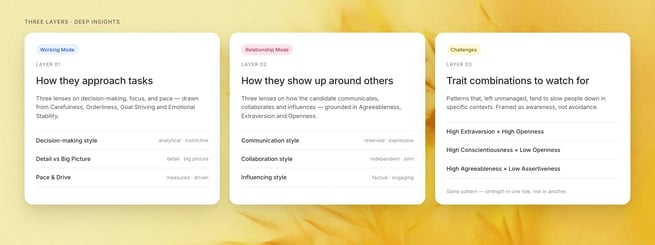
How Challenges read in practice
The Challenges layer needs the most care to read correctly.
Every constellation of personality comes with its own challenges. The Challenges layer surfaces them as patterns to be aware of in a specific role, in the same spirit as the rest of the report: structured observations a hiring team can coach for in context.
The specific patterns that surface are different for every candidate. Deep Insights generates them from whatever traits stand out most in that person's profile, so each report surfaces its own set. There's no fixed catalogue to memorise, and what reads as a challenge in one role often reads as a strength in another.
Two illustrative examples from real reports:
High Extraversion × High Openness
Risk of losing interest and engagement when work is no longer new. Useful to know if you're hiring for a role with long stretches of repetition.
High Conscientiousness × Low Openness
Risk of rigid perfectionism and clinging to established procedures. Useful to know if the role demands rapid pivots.
"The depth you've asked for, with the readability you're used to from Alva."
Both examples make the same point in two different ways: the value of a Challenges sits in the role, not in the trait. Deep Insights names the pattern it observes in this candidate. The hiring team weighs it against the demands of the actual role they're hiring for.
Where Deep Insights fits in the hiring system
Deep Insights complements Role Fit. It doesn't replace it.
Role Fit handles the structured comparison across candidates. Deep Insights handles the qualitative read once the shortlist is short. The two work together: Role Fit narrows the field, assessments measure potential, structured interviews check competence and culture, Deep Insights goes deeper on the finalists, and references and the offer close it out.
The use cases that benefit most: late-stage selection, leadership development, and talent management.
Late-stage selection
Especially for senior and executive hires, where the question is how someone will operate under pressure, sustain performance over time, and handle ambiguity.
Leadership development
As input to coaching, leadership programs, and onboarding into new roles. The same data that informed the hire becomes the foundation for development.
Talent management
Identifying high-potential employees and understanding future capability beyond current performance.
For leadership-specific roles, Deep Insights pairs naturally with the Leadership Report, which applies a research-backed leadership lens to the same Five-Factor data.
→ How Alva's Personality Test works
.webp?width=400&height=324&name=hero_Sumit-Bajracharya%20(2).webp)

.webp?width=400&height=324&name=hero_Anna-Brodin%20(1).webp)