.png?width=800&name=Untitled%20design%20(8).png)
Put two underwriters in the same insurance company, on the same floor, working under the same rules. Give them the same case. How far apart will their prices be?
Most people guess around 10%. The company's own executives said the same: around 10% would be acceptable. When Olivier Sibony and his co-authors ran the experiment, the gap was 55%.
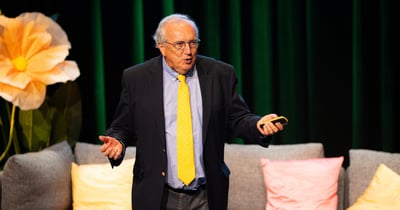
Sibony is Professor of Strategy at HEC Paris and co-author of Noise with Daniel Kahneman and Cass Sunstein. Before academia, he spent 25 years at McKinsey, where he was in charge of talent acquisition for a while. He has made his share of hiring mistakes, and he said so on stage.
He opened Meeting of the Minds 2026 at Cirkus in Stockholm with one message for the TA leaders in the room: hiring judgment is shakier than it feels. AI can make that worse, or it can help you fix it. It depends on how you use it.
Hiring is a prediction problem
That 55% gap is what Sibony calls noise. Bias is when everyone is wrong in the same direction. Noise is when people scatter. They might even be right on average, but that doesn't help you. You only get one underwriter. In hiring, you only get one decision.
HR is one of the noisiest places to make decisions. Interviewers who meet the same candidate don't agree very closely. Panel interviewers disagree too, even when they sit in the same room on the same day. And analysis of 360-degree feedback shows that roughly three quarters of the variance in performance ratings is noise. About one quarter reflects actual performance.
"What you're doing when you're hiring someone is solving a prediction problem. You're trying to predict whether the person you're hiring is going to be successful."
So how good are we at that prediction? Sibony asked the room to picture two candidates. You prefer one after the interviews. How likely is it that your pick is the better candidate?
In public, people usually say 70 to 75%. In private, 85%. The research, much of it from Paul Sackett, puts the real number at around 55%. And that's if you're good. A coin flip gets you 50.
Disagreement is a warning sign
In HR, there is often an "agree to disagree" culture. You liked the candidate, I didn't, that's fine. Sibony pushed back hard on that.
"If two people disagree on a candidate, one of them must be wrong."
Preferring jazz to classical music is taste. Deciding whether a candidate will succeed is a question with a correct answer. When two interviewers land far apart, at least one of them is making an error.
He named three sources of noise:
- Level noise. Some interviewers are severe, others are generous.
- Occasion noise. You're a different interviewer on a sunny Friday afternoon than on a rainy Monday morning.
- Pattern noise. The biggest one. Every candidate reminds each of us of different people and experiences, and we react in our own way.
Noise matters for three reasons. It causes errors, just like bias does. It hurts credibility, because the outcome depends on who happened to do the interview. And it's unfair. A candidate rejected for random reasons is still rejected.
Four AI promises worth questioning
This is where Sibony got sharp. He listed four propositions he keeps hearing from HR teams and AI vendors, and why each one worries him.
1. "Find us clones of our past stars." The people you call successful are successful according to your performance ratings. If those ratings are three quarters noise, the AI learns from noisy data. It will also never suggest the people you haven't hired before. If you've only hired from one engineering school, it will keep sending you that school.
2. "Assess cultural fit from application letters." Sibony asked an HR director at a large, respected company to show him letters the AI had scored as good and poor fits. He couldn't see the difference. When he asked the director to explain it, the answer was: "No, I can't. That's what the AI is for." Sibony compared it to graphology, the handwriting analysis French companies once used in hiring.
"Just because it's AI, it's sophisticated technology and it's trendy, doesn't mean that you should abdicate your common sense. If you don't understand how it works, don't use it."
3. "Let AI analyse video interviews." Research on facial expression analysis shows it's very noisy. Whether any of it predicts performance is unclear. The AI will always give you an answer. Without serious scientific validation, you can't know if the answer is any good.
4. "AI will remove bias." There are many definitions of bias and fairness, and several of them are mutually exclusive. No AI will choose the right one for you. That's work you need to do yourself.
The common thread: be wary of any AI that promises to spare you the hard questions.
What good AI does: decision hygiene
The right use of AI is to help you do the right thing. Sibony calls the right thing "decision hygiene", and it comes down to three habits:
- Structure your judgments.
- Get multiple independent inputs. This is where diversity of views actually helps.
- Don't let intuition take over too soon. Use it at the end, after the structured work is done.
AI can support every one of those. It can turn a vague job description into explicit criteria. It can make sure every interviewer assesses the same criteria and keeps their assessment separate until it's time to compare. And it can challenge you: What am I missing? Am I inferring beyond the evidence? That makes a decision slower, and better.
It can also fix the basics. Sibony's students tell him they apply to large, respected companies and never hear back. With the application volumes TA teams handle today, every candidate should still get a reply.
"A candidate deserves that email."
Keep the decision. Hand over the laundry.
Sibony was clear that the final hiring decision belongs to a person. A hire is a prediction, and it's also a commitment to making that person successful. Someone has to own it.
The other thing people keep is defining what success looks like.
"AI may help you find what you're looking for, but it should not tell you what you're looking for. Otherwise, you're abdicating your responsibility."
In between, TA teams keep the work that needs judgment: choosing what evidence counts, assessing candidates, challenging the evidence and handling the true exceptions. Everything else can go to the machine.
"You let it do the laundry so you can keep doing the art."
Four things to take back to your team
Sibony closed with four points:
- Hiring judgment is hard, and shakier than it feels.
- That variability is unwanted. It means some of us are wrong.
- Better judgment comes from structure, independent inputs and holding off on intuition.
- AI helps when it enforces that structure.
"AI should not be a shortcut. It should be a way to help you do the hard work by being the backbone of a better process."
That is the principle Alva is built on: validated science at the core, an agent that holds the structure across every role, and a person who makes every decision.
Next up at Meeting of the Minds, Paul Sackett picked up where Sibony left off. → [Read: Paul Sackett on consistency]
.png?width=400&height=324&name=Blog%20header%20%20(1).png)
.png?width=400&height=324&name=Blog%20header%20%20(3).png)